


The Federal Government has declared that Nigeria is entering a new phase of its economic programme, with emphasis shifting from introducing major reforms to making those reforms deliver visible benefits for citizens through jobs, investment, higher production and improved living standards.
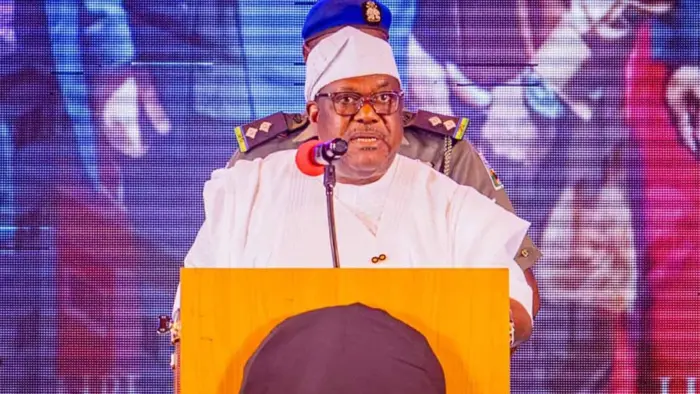
Secretary to the Government of the Federation (SGF), Senator George Akume, made this known on Thursday in Abuja while unveiling plans for Nigeria’s 66th Independence Anniversary.
Akume, who chairs the Inter-Ministerial Committee for the anniversary, said the theme of this year’s celebration “From Reforms to Stability: Consolidating Nigeria’s Renewed Hope for Shared Prosperity” `captured the administration’s intention to consolidate the economic changes introduced since 2023.
He said the government’s immediate challenge was no longer simply to implement reforms, but to ensure that the benefits begin to reach households, businesses and communities across the country.
“The task before us today, as leaders and citizens, is consolidation. We must ensure that the gains from reform translate into better opportunities for ordinary Nigerians,” Akume said.
According to him, the administration’s major economic measures since 2023, including the removal of fuel subsidy and the unification of the foreign exchange market, were introduced to address structural weaknesses and create a more sustainable economic foundation.
He said the government was now focusing on increasing revenue, strengthening public finances, expanding non-oil revenue sources and attracting new investments capable of creating the fiscal space required for development.
Infrastructure, Agriculture Take Centre Stage
Akume identified infrastructure as a key component of the next phase, pointing to ongoing projects across roads, railways, airports, seaports, electricity generation and transmission, as well as digital infrastructure.
He said the broader objective was to make it easier and cheaper for businesses to operate, connect producers to markets and encourage private-sector investment.
Agriculture, he added, would remain another major driver of production and employment, with government interventions covering improved seeds, fertiliser, irrigation, storage and processing.
He cited the National Agricultural Development Fund as part of efforts to increase agricultural output and strengthen agro-industrial value chains.
On education and human capital development, the SGF said the government was working to expand access while improving the quality of teaching and learning.
He particularly mentioned the Nigerian Education Loan Fund as an avenue for more young Nigerians to access tertiary education and acquire skills required in a changing economy.
Security Linked to Economic Growth
Akume also stressed that economic development could not be sustained without security.
He said the government would continue efforts to tackle terrorism, banditry, kidnapping, oil theft and other threats while strengthening intelligence gathering, equipment and coordination among security agencies and local communities.
The SGF further said the government was seeking to make economic opportunities more accessible at the grassroots through the Renewed Hope Ward Development Programme.

According to him, the initiative supports small-scale projects in areas such as agriculture, trade and mining, giving communities a greater role in local economic development.
Akume said the government’s medium-term priorities were captured in the Renewed Hope National Development Plan 2026–2030, which places emphasis on productivity, economic diversification, human capital development and national resilience.
While acknowledging progress in areas such as economic diversification, education and human capital since independence, he admitted that Nigeria continued to face serious challenges, including poverty, insecurity, infrastructure gaps and deficiencies in healthcare and education.
He called for continued cooperation between government and citizens to strengthen institutions and build an economy capable of creating broader opportunities.
“From reforms, we have built stability. From stability, let us now deepen growth and opportunity. And from growth, let us extend shared prosperity to every corner of Nigeria,” he said.
Idris: Real Test Is Impact on Nigerians
Minister of Information and National Orientation, Mohammed Idris, also said the country was moving into a phase where economic stabilisation must give way to stronger production and shared prosperity.
Idris, who chairs the Media and Publicity Sub-Committee for the anniversary, pointed to developments including stronger GDP growth, an improved external position, increased domestic refining capacity and renewed investment as signs of progress.
He, however, said the more important measure would be whether such developments ultimately improve the everyday lives of Nigerians.
“The next phase is to translate these gains into tangible improvements in the lives of Nigerians: more jobs, higher incomes, greater access to education and credit, lower costs and wider economic opportunities,” Idris said.
He said the Renewed Hope Agenda was pursuing these goals through investments in infrastructure, agriculture, education, consumer credit, digital skills, energy and enterprise.
Idris said reforms in agriculture, livestock, solid minerals, oil and gas were increasingly being targeted at boosting production and local value addition, while student loans and consumer credit were intended to widen access to education and economic opportunities.
Independence Anniversary Programme
The Federal Government also unveiled the programme for the 66th Independence Anniversary.
The activities will begin with a Juma’at Service on Friday, September 25, followed by a Church Service on Sunday, September 27.
An Independence Day Public Lecture is scheduled for Wednesday, September 30, while President Bola Tinubu is expected to deliver the nationwide Independence Day broadcast on Thursday, October 1, 2026.
The anniversary theme, according to the government, is intended to mark a transition from the difficult period of economic reforms and stabilisation towards a phase focused more directly on production, employment, investment and improved living conditions.

.jpg)
Comments (0)
No comments yet. Be the first to share your thoughts!