


TAIBAT UMMI YAKUBU
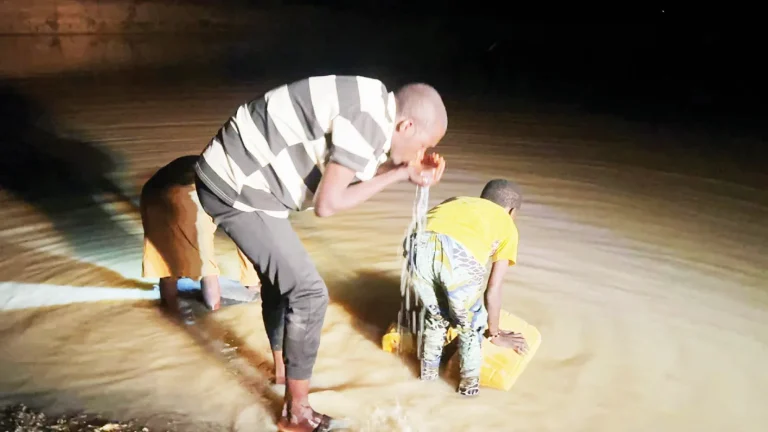
For generations, residents of Rimi-Muduru community in Mani Local Government Area of Katsina State have lived with a water crisis that has turned access to one of life's most basic necessities into a daily struggle. For about 50 years, families in the community have depended on an earth pond also used by cattle and other livestock, with no reliable source of clean water available to them.
The situation has forced residents to share the same water source with animals, raising concerns about the health and safety of people who depend on it for drinking and other domestic activities.
With no alternative, some residents now rely on young water vendors who fetch water from the pond and sell it in 25-litre jerrycans for N450. For households that need several containers every day, the cost quickly becomes a heavy financial burden.
A resident, Aliyu, said the community had struggled with the problem for decades, explaining that access to safe water remained a major challenge for families. He said residents had little choice but to continue using the pond because there was no dependable alternative within their reach.
Another resident, Bala, described how the situation had affected household spending, particularly for families who must buy water regularly to meet their daily needs.
For a household that purchases four jerrycans a day, the expense amounts to N1,800 daily and approximately N54,000 in a month. This is a significant amount for families already struggling to meet other basic needs, especially when water is required for drinking, cooking, bathing, washing and other domestic activities.
The crisis has also placed children and other vulnerable residents at potential risk because the pond is not reserved for human use. Livestock drink from the same source, while people collect water from it for household consumption.
The health implications of such dependence have raised concerns among medical experts. Dr Muhammad Abubakar, an infectious disease specialist and consultant at the Federal Teaching Hospital, Katsina, warned that consuming water exposed to animal waste and other contaminants could expose residents to several infections.
He explained that unsafe water could contain bacteria, viruses and parasites capable of causing illnesses. He also highlighted the possibility of zoonotic infections, diseases that can spread between animals and humans, including brucellosis and bovine tuberculosis.

Abubakar noted that the presence of children and other residents using the pond makes the situation particularly concerning, as contaminated water can contribute to illnesses, including diarrhoeal diseases. However, he stressed that it would be necessary to conduct proper medical and epidemiological investigations before linking specific illnesses in the community directly to the water source.
He said water samples would need to be collected and tested to establish the level of contamination and identify possible disease-causing organisms. He also advocated a One Health approach, which recognises the connection between human, animal and environmental health, as part of efforts to address the risks associated with the shared water source.
For the residents of Rimi-Muduru, however, the immediate concern remains the absence of an accessible and reliable supply of safe water. Beyond the health risks, the daily cost of buying water has added to the hardship of families who cannot afford to continue paying for every container they need.
The situation also raises questions about the availability of basic public services in rural communities, where access to clean water remains essential to public health, education, household welfare and economic activities.
Efforts to obtain the response of the Katsina State Commissioner for Water Resources, Manir Ayuba, were unsuccessful, as he did not respond to telephone calls seeking comments on the community's water crisis.
Until a lasting solution is provided, residents of Rimi-Muduru may remain trapped in a difficult reality: paying heavily for water that raises serious health concerns, or continuing to depend on a pond shared with livestock.
For a community that has endured the problem for about five decades, access to clean and safe water is no longer simply a development request. It is an urgent necessity that affects the health, dignity and everyday survival of its people.


Comments (0)
No comments yet. Be the first to share your thoughts!