


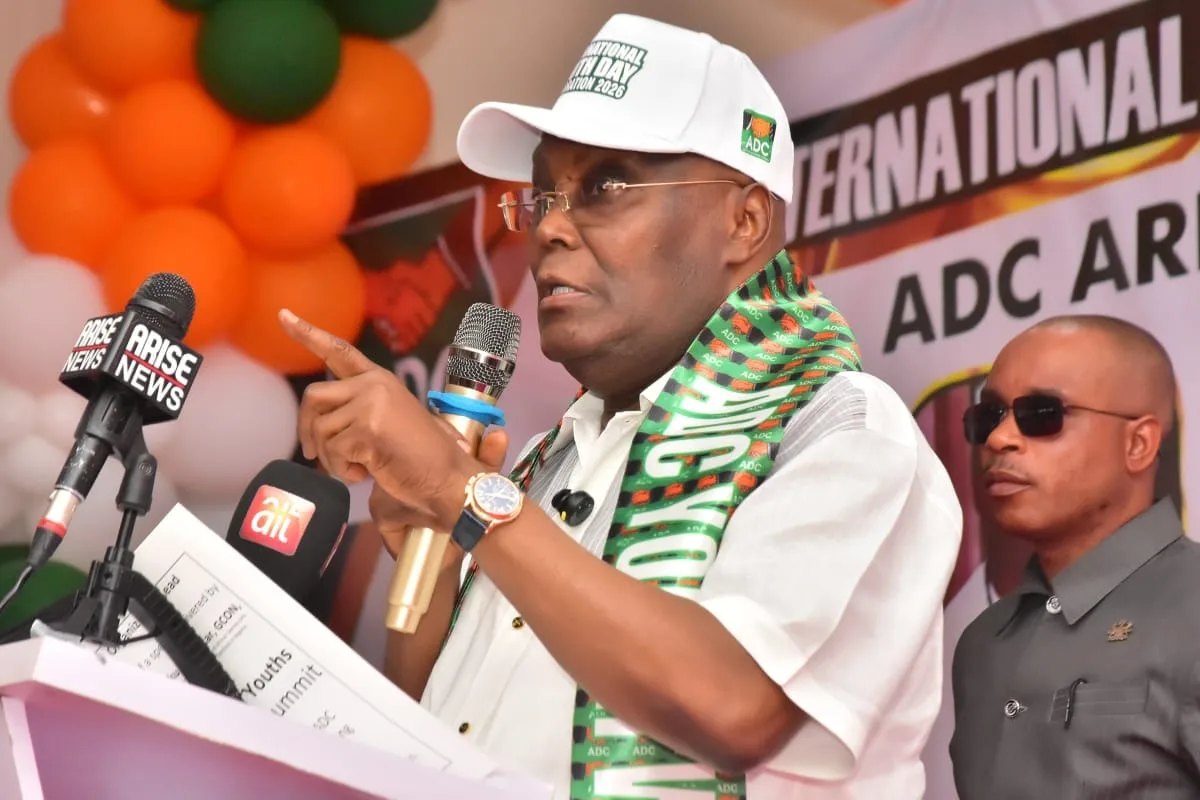
Presidential candidate of the African Democratic Congress (ADC), Atiku Abubakar, has thrown his support behind organised labour’s demand for a significant increase in Nigeria’s minimum wage, arguing that the current wage no longer reflects the rising cost of living facing workers.
Atiku, through a statement issued by the Director of Strategic Communications of the ADC Presidential Campaign Council, Phrank Shaibu, accused President Bola Ahmed Tinubu’s administration of worsening the pressure on workers despite the increase in the statutory minimum wage from ₦30,000 to ₦70,000.
He argued that while the figure on workers’ payslips has increased, the purchasing power of that money has fallen sharply because of rising fuel, transportation, food and housing costs.
According to Atiku, the removal of petrol subsidy triggered a steep increase in living expenses without adequate protection being put in place for working families.
“The government pulled away the floor, offered workers a flimsy umbrella and now applauds itself while the rain beats down on them,” he said.
He said the rising prices of essential commodities had effectively swallowed much of the additional income workers were expected to benefit from under the new minimum wage.
Atiku illustrated his argument with petrol prices, noting that a worker earning ₦70,000 would be able to purchase only about 50 litres of petrol if fuel sold at ₦1,400 per litre.
He contrasted that with the purchasing power of the former ₦30,000 minimum wage in April 2023, when the national average petrol price was about ₦254.06 per litre. At that price, he said, ₦30,000 could purchase approximately 118 litres.
“The payslip has grown, but the fuel it can buy has more than halved. Tinubu has given workers a larger number and left them with a smaller life. That is hardship dressed up as a wage increase,” Atiku said.
He argued that the impact of inflation could not be measured by salary figures alone, insisting that the more important question was what workers could actually afford with their earnings.
According to the former Vice President, workers are now being forced to stretch their incomes across increasingly expensive necessities, including transportation, food, rent and other household expenses.
“At ₦1,400 a litre, the entire ₦70,000 monthly minimum wage buys just 50 litres of petrol. What does the worker take home to feed the children? What pays the rent? What gets that worker back to work on Monday?” he asked.

Atiku also compared Nigeria’s minimum wage with those of a number of African and oil-producing countries, using exchange rates from July 24, 2026.
He said Libya’s monthly minimum wage was equivalent to about ₦213,000, while Algeria’s stood at approximately ₦245,000. Equatorial Guinea and Gabon, he added, had minimum wages equivalent to about ₦302,000 and ₦351,000 respectively.
He also pointed to neighbouring Benin Republic, saying its minimum wage was higher than Nigeria’s when converted using the same exchange rates.
Atiku acknowledged that wage structures, taxation, exchange rates and living costs vary from one country to another, but maintained that such differences did not change the financial difficulties confronting Nigerian workers.
He described workers as a critical part of the country's productive economy and argued that their wages should allow them to meet basic household needs.
“The Nigerian worker is the engine of this country’s productive life, yet Tinubu expects that engine to run without fuel,” he said.
He painted a picture of workers leaving their homes before dawn, spending a significant portion of their earnings on transportation and returning home with little left for food and other family responsibilities.
“That is a national disgrace. You cannot work people to exhaustion, pay them into poverty and lecture them about productivity,” Atiku said.
“If a full month’s wage cannot sustain a worker’s family, government has failed the people who keep this country moving.”
His comments come as organised labour continues to push for improved wages and stronger measures to cushion the impact of the rising cost of living on Nigerian workers.



Comments (0)
No comments yet. Be the first to share your thoughts!