


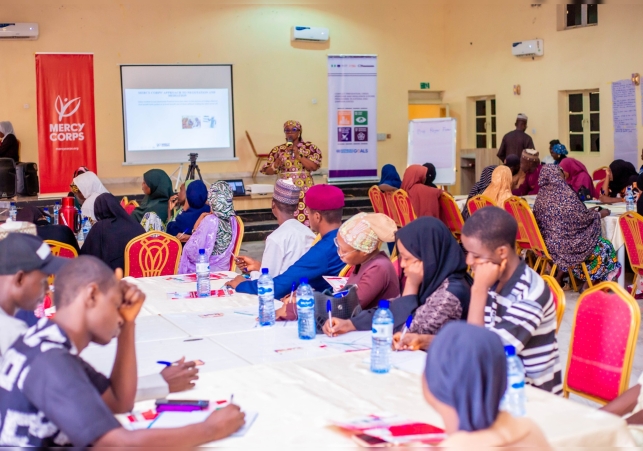
In a renewed effort to tackle recurring community conflicts and strengthen peaceful coexistence, women and youths from four Local Government Areas of Katsina State have commenced a specialised training programme designed to equip them with practical skills in conflict prevention, dispute resolution, and sustainable resource management.
The four-day capacity-building workshop, which began in Katsina on Monday, is being implemented under the European Union-funded Conflict Prevention, Crisis Response and Resilience (CPCRR) Programme. The initiative is jointly executed by the International Organization for Migration (IOM), Mercy Corps, and the Centre for Democracy and Development (CDD).
Participants drawn from Safana, Faskari, Sabuwa, and Dandume local government areas include farmers, herders, women, youths, and persons with disabilities. Also participating are officials from the Katsina State Ministries of Youth and Sports Development as well as Women Affairs.
Speaking at the opening session, Senior Programme Manager of Mercy Corps, Philip Ikita, said the intervention seeks to transform how communities handle disputes by encouraging dialogue, understanding, and cooperation instead of confrontation.
According to him, the programme recognises the crucial role women can play in sustaining peace, despite often being among the most affected by communal conflicts and yet frequently excluded from formal peacebuilding processes.
Ikita explained that the training focuses on Interest-Based Negotiation, an approach that encourages parties in conflict to identify shared interests and common goals rather than concentrating on opposing positions.
He noted that the initiative aims to strengthen participants’ abilities to communicate effectively, negotiate constructively, and build trust within their communities.
“The goal is to empower community women with practical skills to manage and resolve local disputes through negotiation methods that promote mutual understanding and shared interests,” he said.
He added that the training would enhance collaboration among community members and improve their capacity to address conflicts linked to access and use of natural resources.

Beyond conflict resolution, the programme is also placing significant emphasis on sustainable resource management, a growing concern in many rural communities where competition for land, water, forests, and grazing areas often fuels tensions.
The second phase of the training, scheduled for August 12 and 13, will focus on Community and Social Development Resource Management. Participants will be exposed to strategies for managing shared resources in ways that reduce conflict and promote long-term sustainability.
Ikita said the session is particularly relevant to communities where disputes between farmers, herders, and other resource users frequently arise due to increasing pressure on natural resources.
He explained that participants would gain knowledge on climate-related and resource-driven conflicts, while also learning practical approaches to local resource mapping, conservation, and sustainable utilisation.
According to him, the broader objective is to equip communities with the tools needed to manage shared resources responsibly while promoting social harmony and preventing disputes before they escalate.
The programme is expected to strengthen collaboration among women, youths, community leaders, and other stakeholders, creating stronger local networks for peacebuilding, environmental stewardship, and inclusive community development.
Observers say the initiative comes at a critical time when many communities across northern Nigeria are grappling with resource-based tensions, making grassroots peacebuilding efforts increasingly important for long-term stability and development.

Comments (0)
No comments yet. Be the first to share your thoughts!