


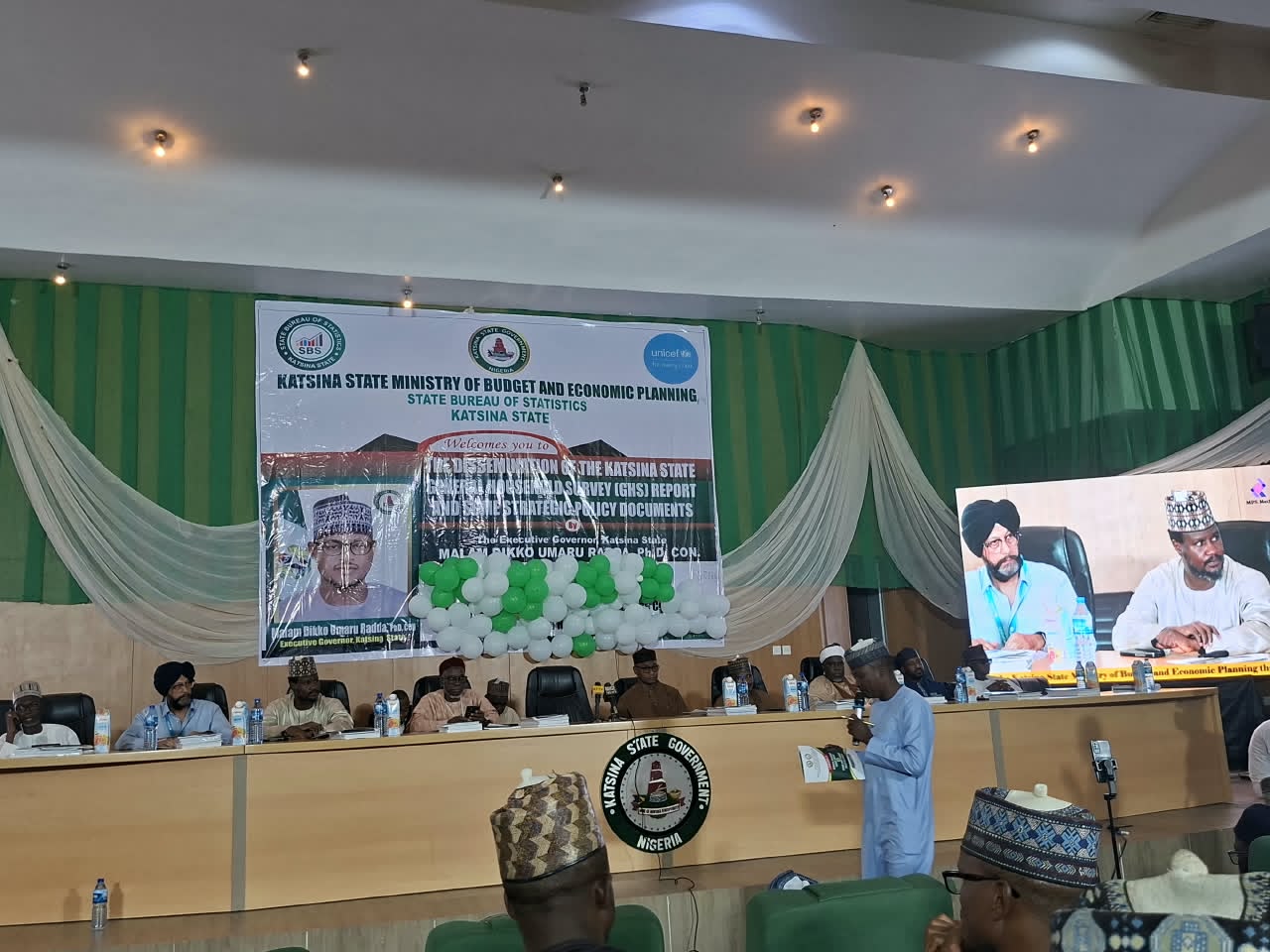
The Katsina State Government has taken a major step toward data-driven governance with the launch of its General Household Survey (GHS) Report, a comprehensive document expected to reshape how development programmes, public spending and social interventions are designed across the state.
The report, unveiled on Thursday by Governor Dikko Umaru Radda through his deputy, Alhaji Faruq Lawal Jobe, provides an extensive assessment of the living conditions of households across all 34 local government areas of Katsina State, offering government officials, development partners and policymakers an unprecedented insight into the realities facing residents.
The survey captures a broad range of socio-economic indicators, including poverty levels, household welfare, employment, agriculture, education, healthcare, housing, water supply, sanitation, access to essential services and social protection programmes.
Speaking at the launch, Governor Radda described the report as a significant milestone in the state's quest to institutionalise evidence-based governance, stressing that future development initiatives would increasingly be guided by facts rather than assumptions.
According to him, the availability of credible and reliable data will enable government institutions to identify pressing challenges more accurately, direct resources to areas of greatest need and objectively measure the impact of public policies and programmes.
The governor noted that effective governance requires a clear understanding of the realities facing citizens and argued that the survey would provide decision-makers with the evidence needed to craft policies that respond directly to those realities.
He said the report would serve as a critical planning tool for ministries, departments and agencies, adding that government institutions would now be expected to incorporate statistical evidence into policy formulation, budgeting, strategic planning and performance evaluation processes.
Radda further emphasized that strong statistical systems are essential for transparency, accountability and public trust, noting that reliable data not only benefits government planning but also provides investors with credible information about economic opportunities and development prospects within the state.
The governor described the survey as part of his administration's broader commitment to strengthening governance through rigorous analysis, stakeholder engagement and evidence-based decision-making.
He also acknowledged the role played by UNICEF's Kano Field Office, whose technical and financial support contributed to strengthening planning systems, statistical capacity and data generation efforts in Katsina.
Urging stakeholders to maximise the value of the report, Radda called on local government councils, ministries, development agencies, researchers, civil society organisations and private sector actors to utilise the findings in designing programmes capable of improving the wellbeing of residents.
Earlier, the Commissioner for Budget and Economic Planning, Malam Malik Anas, said the survey provides one of the most detailed pictures yet of the socio-economic realities confronting households across the state.
According to him, the findings offer critical insights into poverty patterns, vulnerabilities and the challenges preventing many families from improving their living standards.
He explained that the report would help government identify not only who requires support but also where they are located and the specific factors contributing to their economic hardship.

Anas noted that such information is vital for ensuring that limited public resources are directed toward communities and population groups where interventions can achieve the greatest impact.
He added that the survey would also serve as a baseline for assessing progress under the state's development agenda, enabling government and partners to track improvements over time and evaluate the effectiveness of policy interventions.
The commissioner reaffirmed the administration's commitment to strengthening institutions responsible for data generation and management, including the Ministry of Budget and Economic Planning and the Katsina State Bureau of Statistics.
He described the report as a valuable resource that will support the work of policymakers, academics, development organisations and civil society groups involved in shaping the state's future.
Also speaking at the event, the Officer-in-Charge of UNICEF's Kano Field Office, Dr. Karanveer Singh, praised the Katsina State Government for prioritising evidence-based planning and accountability.
Singh said the survey represents far more than a statistical exercise, describing it as a practical tool capable of improving outcomes for children, women, families and vulnerable communities when effectively utilised.
According to him, the report provides timely and credible evidence on the living conditions, needs and priorities of households across the state, making it an essential guide for policy formulation and resource allocation.
He noted that data-driven decision-making remains critical to achieving sustainable development goals and improving service delivery, particularly in sectors such as health, education, nutrition and social protection.
The UNICEF official reiterated the organisation's commitment to supporting Katsina State in strengthening data systems and implementing policies that improve the quality of life of its residents.
While congratulating the state government, the Bureau of Statistics and other stakeholders involved in producing the report, Singh urged authorities to ensure that the findings do not remain on paper.
He stressed that the true value of the survey lies not in its publication but in its ability to influence practical actions, measurable outcomes and meaningful improvements in the lives of the people.
With the launch of the General Household Survey Report, Katsina is positioning itself to make development decisions based on evidence rather than speculation—a move stakeholders believe could significantly improve the effectiveness of government programmes and accelerate progress across critical sectors of the state's economy and society.
.jpg)


Comments (0)
No comments yet. Be the first to share your thoughts!