


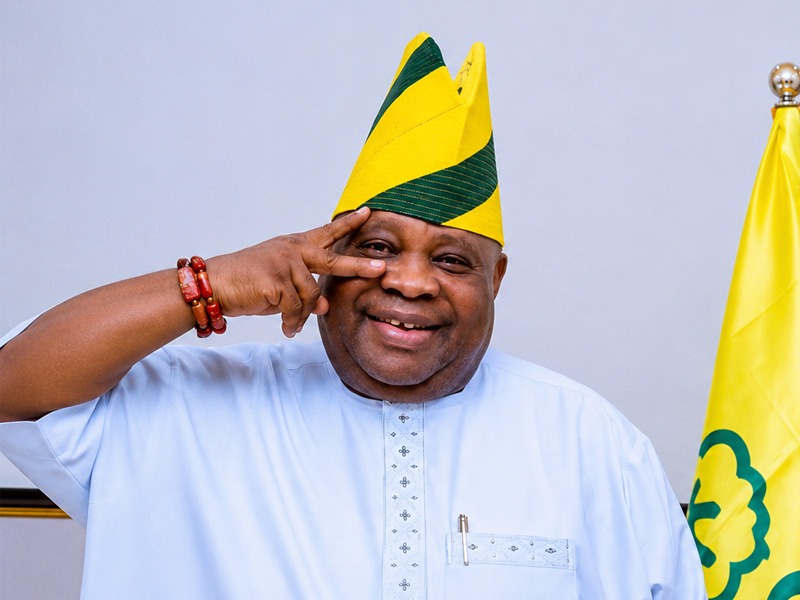
Governor Ademola Adeleke has secured a second term in office after emerging victorious in Saturday's Osun State governorship election, in a result that is already generating conversations across Nigeria about the power of the ballot and the growing maturity of the country's democracy.
The Independent National Electoral Commission (INEC) on Sunday declared Adeleke, the candidate of the Accord Party, winner of the keenly contested election after polling 511,067 votes.
Announcing the result in Osogbo, the Returning Officer for the election, Prof. Joshua Ogunwole, said Adeleke met all constitutional requirements and scored the highest number of lawful votes cast.
"I hereby certify that I am the Returning Officer for the 2026 Osun governorship election held on Aug. 15 and declare that Ademola Jackson Adeleke of the Accord Party, having satisfied the requirements of the law, is hereby declared the winner," Ogunwole stated.
According to the final figures released by INEC, a total of 1,005,800 votes were cast during the election. Of the figure, 985,079 votes were declared valid, while 20,721 ballots were rejected.
A breakdown of the results showed that Adeleke garnered 511,067 votes to defeat the candidate of the All Progressives Congress (APC), Bola Oyebamiji, who secured 444,815 votes. The African Democratic Congress (ADC) candidate, Najeem Salaam, finished a distant third with 17,180 votes.
The election map also reflected Adeleke's dominance across the state, as he won in 19 of Osun's 30 local government areas, leaving 11 councils for the APC candidate.
Beyond the figures, however, Adeleke's victory carries a deeper political message.
The governor's re-election comes months after his dramatic exit from the Peoples Democratic Party (PDP) to the Accord Party, a move many political observers initially viewed as a major gamble that could weaken his political structure ahead of the election.

Instead, the outcome appears to have demonstrated the strength of his personal political appeal and grassroots support across Osun State.
For many Nigerians, the result reinforces a growing belief that voters, rather than party labels alone, can determine electoral outcomes.
Political analysts note that the election offers another example that electoral victory is no longer exclusively tied to belonging to the country's dominant political platforms. Adeleke's ability to retain public support despite changing political parties is being interpreted by many as evidence that voters are increasingly making choices based on candidates, performance and local political realities.
The outcome is also likely to reignite discussions about the importance of voter participation.
Across social media and political circles, many citizens described the result as proof that "every vote counts," arguing that the election reflected the collective decision of Osun voters rather than the influence of political heavyweights.
So far, reports from election observers and stakeholders suggest that the process was largely peaceful and competitive, with voters freely exercising their democratic rights across the state. While political parties may still scrutinise aspects of the exercise, the conduct of the poll has been widely viewed as another important test of Nigeria's electoral system.
With the victory, Adeleke has now secured a fresh four-year mandate and is expected to be sworn in for a second term on Nov. 27.
As celebrations erupt among his supporters, the election leaves behind a message that may resonate far beyond Osun's borders: in a democracy, political structures matter, but ultimately, the ballot remains the most powerful weapon in the hands of the people.

Comments (0)
No comments yet. Be the first to share your thoughts!