


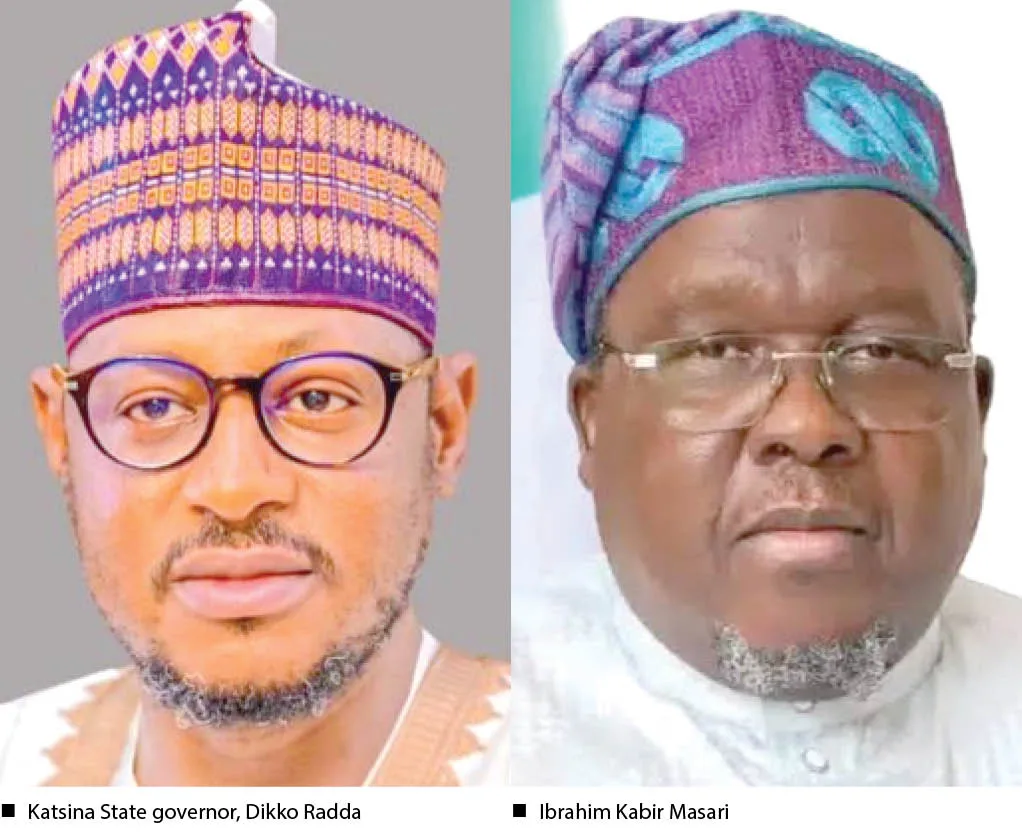
Fresh cracks appear to be emerging within the ruling All Progressives Congress (APC) in Katsina State as the reported interrogation of two top security aides to Governor Dikko Umaru Radda has fueled speculation about an escalating political battle involving powerful interests within the party.
At the centre of the controversy are the governor’s Aide-de-Camp (ADC), SP Abdulganiyu Bello, and Chief Security Officer (CSO), DSP Hassan Bello, who were invited to the Nigeria Police Force Headquarters in Abuja for questioning over allegations linked to the destruction of political billboards in Katsina.
The incident has quickly evolved from a routine police matter into a politically charged issue, exposing what many observers describe as a growing divide between Governor Radda’s camp and allies of the Special Adviser to President Bola Ahmed Tinubu on Political Affairs, Ibrahim Kabir Masari.
Police Confirm Questioning, Deny Arrest
Reports that the two officers had been arrested and detained triggered widespread reactions across Katsina's political landscape. However, the Nigeria Police Force dismissed such claims.
Force spokesman, Chief Superintendent of Police Anietie Iniedu, confirmed that both officers were invited for questioning but insisted they were neither arrested nor detained.
“They were invited for an interview. They were not arrested or detained,” he said.
Despite the clarification, uncertainty remains over the status of the officers, with conflicting reports suggesting they have not been seen publicly in Katsina since their appearance in Abuja.
The Billboard Controversy
Sources familiar with the matter said the officers were questioned over allegations surrounding the destruction of billboards erected along the Modoji Junction-Government House Road in Katsina.
The billboards reportedly featured large photographs of President Tinubu and Ibrahim Masari, while Governor Radda's image appeared either minimally or, in some cases, was allegedly absent altogether.
The displays quickly became a talking point among political observers, with some interpreting them as subtle attempts to project alternative centres of political influence within the state.
Others argued that the controversy reflected deeper disagreements that have been simmering beneath the surface of the APC in Katsina.
Masari, a long-time political ally of President Tinubu and one of the most influential figures from Katsina in the federal government, is widely regarded as a key power broker. His political relevance dates back to the 2023 elections when he temporarily served as Tinubu's placeholder vice-presidential nominee before the eventual selection of Vice President Kashim Shettima.
Growing Signs of an Internal APC Divide
The billboard incident comes amid growing speculation of a widening gulf between political actors operating from Katsina and influential APC figures based in Abuja.
The tension gained further momentum after Governor Radda and several of his close associates were noticeably absent from the recently announced Presidential Campaign Council ahead of the 2027 election cycle.
Within political circles, the development has reinforced narratives of two emerging blocs within the APC.
One faction, often described as the "Katsina APC," consists largely of party loyalists and political stakeholders aligned with Governor Radda and based within the state.
The second group, popularly referred to as the "Katsina-Abuja APC," is believed to comprise influential federal appointees and politicians from Katsina who hold strategic positions in Abuja.
Although party leaders have repeatedly downplayed suggestions of a rift, many observers believe the latest developments have brought the alleged divisions into sharper focus.
Governor Radda himself had previously hinted at the existence of forces working from Abuja to undermine his administration, promising that the identities of such individuals would be revealed at an appropriate time.
Dangiwa's Exit Adds Fuel to Speculation
Political discussions surrounding the alleged divisions intensified following the removal of former Minister of Housing and Urban Development, Ahmed Musa Dangiwa, from the Federal Executive Council.

Dangiwa, widely perceived as a close ally of Governor Radda, previously served as Secretary to the Katsina State Government before joining President Tinubu's cabinet.
His replacement by Engineer Mutaqa Rabe Darma, who is believed to enjoy strong ties with Masari's political camp, further deepened speculation that shifting political alliances were taking shape ahead of the next electoral cycle.
While no official connection has been established between the ministerial change and the ongoing APC tensions, the timing has continued to fuel debate among party supporters and political analysts.
Analysts Warn of 2027 Consequences
Political analyst Dr. Bashir Ibrahim Kurfi believes the developments point to an underlying struggle that could have significant implications for the APC's future in Katsina.
According to him, the omission of Governor Radda and some of his allies from the presidential campaign structure has strengthened public perceptions that relations between the governor's camp and influential APC figures in Abuja may not be as cordial as party leaders claim.
Kurfi warned that unresolved disagreements could weaken party cohesion and create openings for opposition parties ahead of the 2027 elections.
A senior APC stakeholder, Musa Nuhu Gafiya, also urged both sides to pursue reconciliation, arguing that prolonged disagreements would only provide political ammunition to opposition forces already exploiting the situation on social media.
Radda Camp Dismisses Crisis Claims
Despite the growing speculation, officials close to the governor insist there is no crisis.
Governor Radda's Special Adviser on Political Matters, Alhaji Ya'u Umar Gwajo-Gwajo, dismissed reports of serious disagreements within the party, describing the situation as routine political maneuvering often associated with early campaign activities.
He maintained that Governor Radda continues to enjoy a strong working relationship with President Tinubu and remains actively involved in preparations for the President's anticipated 2027 re-election bid.
Gwajo-Gwajo also stated that the Katsina State Government had no information regarding claims that individuals from the state were being detained in Abuja.
Similarly, the Director-General of Media to the Governor, Maiwada Danmalam, said he was unaware of any rift between Governor Radda and Ibrahim Masari.
Danmalam noted that he had only encountered reports of the alleged disagreement through media publications and had not received any official briefing suggesting the existence of political hostilities between the two men.
He urged journalists and members of the public to approach politically sensitive matters with caution and avoid spreading unverified claims capable of generating unnecessary tension.
A Party at a Crossroads
Whether the latest developments represent a genuine political confrontation or merely strategic maneuvering ahead of the 2027 elections remains a matter of debate.
What is clear, however, is that the interrogation of Governor Radda's security aides, the controversy surrounding the billboards, the restructuring of political alliances, and the growing speculation over competing power centres have combined to place the Katsina APC under intense scrutiny.
As political calculations for 2027 gather momentum, stakeholders within the party face increasing pressure to close ranks and address lingering questions about unity, loyalty and influence.
For now, the APC in Katsina finds itself navigating a delicate moment—one that could either be remembered as a temporary misunderstanding among party leaders or the beginning of a deeper political struggle that reshapes the state's power dynamics in the years ahead.
Comments (0)
No comments yet. Be the first to share your thoughts!