


Nigeria's drug problem is growing faster than many people realise.
Behind the seizures of illicit substances and the arrests regularly announced by the National Drug Law Enforcement Agency (NDLEA) lies a much bigger concern, millions of Nigerians, including women and young people, are battling substance abuse, creating what experts describe as a public health and social emergency.
For Brig.-Gen. Mohamed Buba Marwa (Rtd), Chairman and Chief Executive Officer of the NDLEA, the reality is clear: the agency cannot tackle the crisis alone.
Speaking in Abuja during a meeting with the Initiative for Women's Accelerated Development in Africa (INWOAD), Marwa called for a nationwide coalition involving government institutions, community leaders, civil society organisations, women's groups and the media to confront what he described as one of Nigeria's most pressing challenges.
The former military administrator painted a troubling picture of the country's drug landscape.
According to him, about 15 million Nigerians are involved in drug use, representing nearly one out of every seven citizens. Even more concerning, he noted, is the increasing participation of women in substance abuse.
"One in every four drug users is a woman," he said.
The figures become even more alarming when cannabis use is considered. Marwa disclosed that more than 10 million Nigerians consume cannabis, making it the most commonly abused drug in the country.
For the NDLEA boss, these statistics are evidence that the country must rethink how it approaches the fight against drugs.
For years, public attention has largely focused on arrests, seizures and prosecutions. However, Marwa believes the real battle begins long before drugs reach the streets.
"The challenge is not just about intercepting drugs. We must also stop people from becoming drug users in the first place," he said.
He argued that enforcement alone cannot solve a problem driven by poverty, peer influence, family breakdown, unemployment and inadequate awareness.
As a result, he called for sustained campaigns in schools, neighbourhoods and homes, stressing that parents, especially mothers, must be empowered with the knowledge and tools needed to identify early warning signs of substance abuse.
His remarks resonated with members of the visiting INWOAD delegation, who expressed concern over the devastating impact of drug abuse on families and communities.
Advertisement

Leading the delegation, the organisation's founder, Lady Evelyn Onyilo, said the fight against substance abuse aligns with INWOAD's broader mission of empowering women and protecting vulnerable groups.
She noted that while the conversation around drugs often focuses on users, the consequences extend far beyond the individual.
"When a young person becomes addicted, it affects the family, the community and the nation's future," she said.
Onyilo praised the NDLEA's efforts under Marwa's leadership and pledged her organisation's support for awareness campaigns, public enlightenment programmes and community-based interventions.
She said women must play a central role in prevention efforts because of their influence within families and communities.
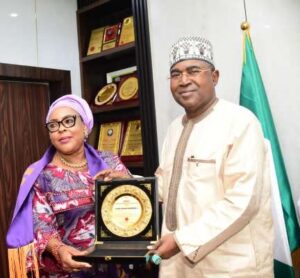
As part of the visit, Marwa was presented with the "Champion of Drug-Free Nigeria Award" in recognition of his contributions to the country's anti-drug campaign.
But beyond the award ceremony and formal speeches, the meeting highlighted a growing consensus among stakeholders: Nigeria's drug crisis can no longer be treated solely as a law enforcement issue.
Experts increasingly argue that substance abuse should be approached as both a security challenge and a public health concern requiring education, rehabilitation, community engagement and long-term social investment.
With millions of Nigerians already affected and drug abuse spreading across age groups and social classes, the message from Abuja was unmistakable.
The fight against drugs is no longer the responsibility of the NDLEA alone. It is a battle that demands the involvement of families, schools, religious institutions, community leaders, the media and every sector of society.
And for Marwa, the stakes could not be higher.
"If we fail to protect our young people from drugs," he warned, "we risk losing the future."


Comments (0)
No comments yet. Be the first to share your thoughts!